Citystate Metropolis simulates inequality, economic segregation, social mobility, gentrification, urban decay and crime. Your zoning rules, taxes and services decide who can afford to live where. The developer calls this the game’s sharpest edge: “I didn’t want the urban dynamics to feel bland.” This guide sets out what the official Steam page and the November 18, 2026 announcement confirm, plus what the official screenshots show, before the December 10, 2026 Early Access launch.
Quick facts
- Simulated
- Inequality, segregation, mobility, crime
- Also
- Gentrification, urban decay, income disparity
- Residents
- Low, middle and high income
- Buildings
- Wealth level that can upgrade
- Slums
- Planned for 1.0, not at launch
What the developer says is in the simulation
The Steam page: “the city can accurately model the consequences of building regulations and city policies on its inhabitants. Income disparity, gentrification, urban decay, and other socioeconomic factors haven’t been brushed off and are front and center in the city’s development.”
The announcement goes further: “It doesn’t shy away from real-world topics… inequality, economic segregation, social mobility and crime are all in there. So if you’re inclined to see it that way, it can all be very political. Consider yourself warned.”
He also explains the scale: the simulation is “crowd-based (as opposed to agent-based)”, which lets it handle populations over a million while still modelling these effects.
Three income groups
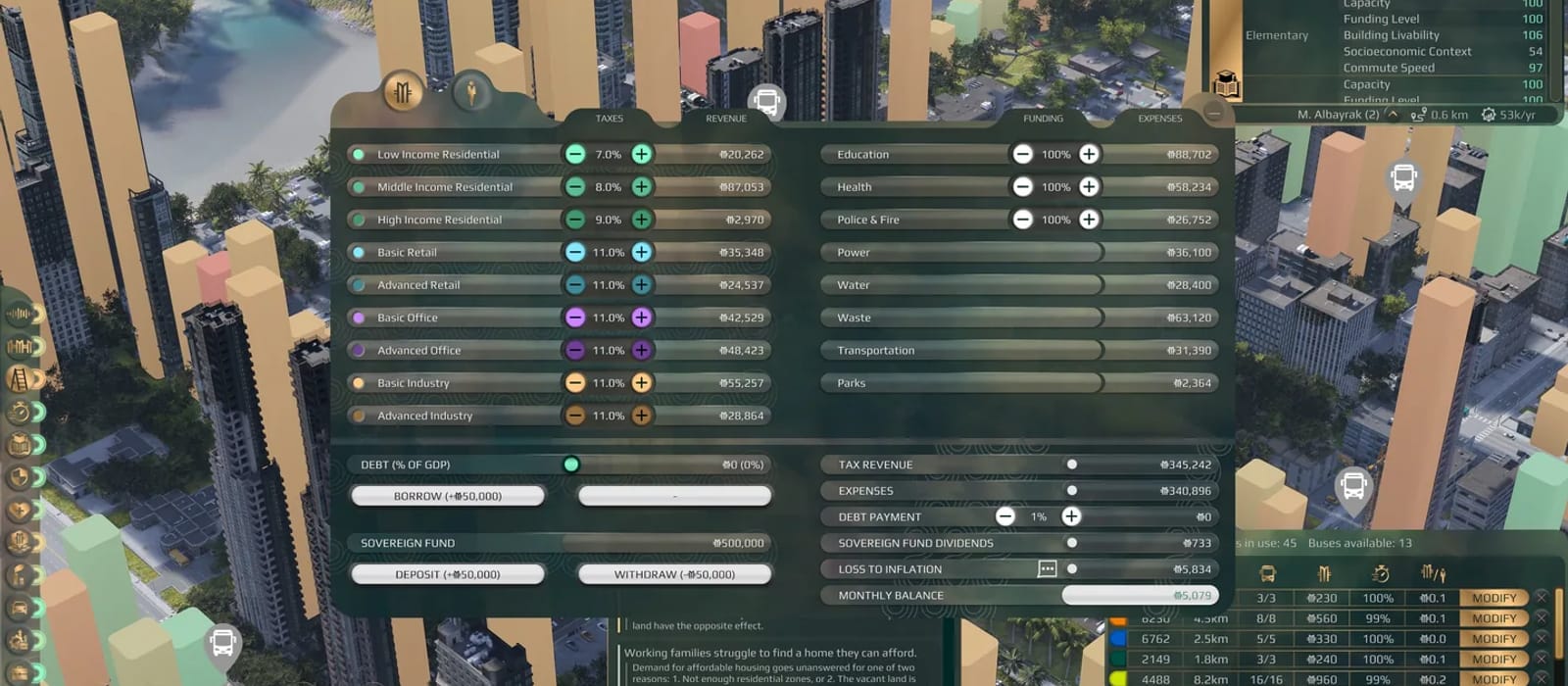
The official budget panel splits residents into Low Income, Middle Income and High Income Residential, each with its own tax rate. Businesses split into basic and advanced retail, office and industry. Most of the social simulation flows from this split: who lives in which building, and what they can afford.
Building wealth levels and gentrification
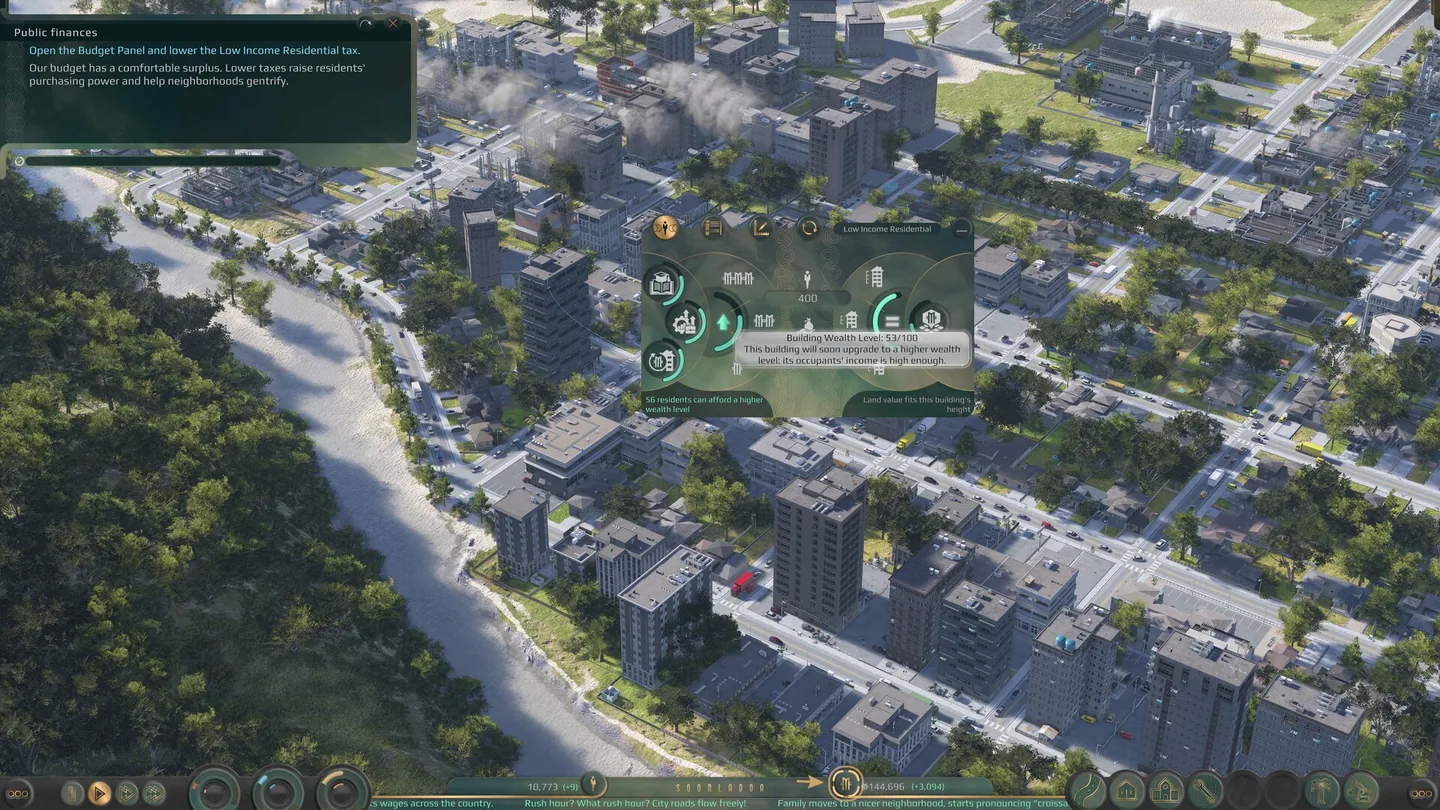
A tutorial screenshot shows how a neighbourhood moves up. A Low Income Residential building shows “Building Wealth Level: 53/100” with the note “This building will soon upgrade to a higher wealth level: its occupants’ income is high enough.” Below it: “56 residents can afford a higher wealth level”, and “Land value fits this building’s height.”
The tip beside it ties this to policy: “Lower taxes raise residents’ purchasing power and help neighborhoods gentrify.” In plain terms, when residents’ incomes rise, buildings upgrade, the area becomes more expensive, and land value goes up.
The affordable housing problem
Gentrification has a cost. In the developer’s budget screenshot, the city’s message feed reads: “Working families struggle to find a home they can afford. Demand for affordable housing goes unanswered for one of two reasons: 1. Not enough residential zones, or 2. The vacant land is only available in the city’s pricier neighborhoods.”
That is the game’s version of a housing crisis. Fixing it is a zoning job: zone more housing, or zone it where land is cheaper. The Steam page gives the general rule: “Build simple and cheap to decrease housing costs and foster social mobility. Build fancy and eco-friendly to increase land value and attract foreign investors.”
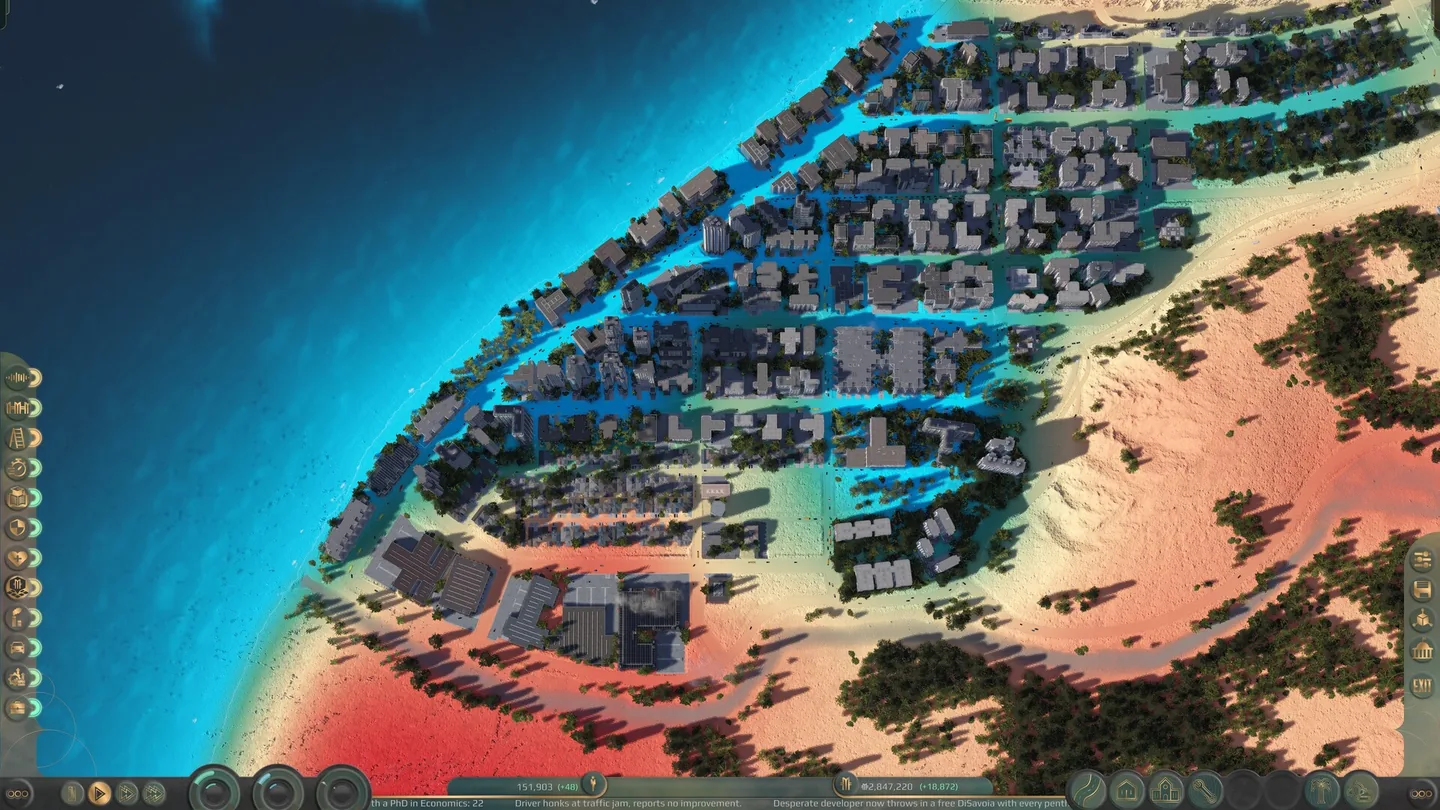
One official screenshot shows a heat-map style overlay running from blue to red across a coastal town. The game hasn’t labelled it publicly, so we can’t say which value it shows. Land value is a likely candidate, since land value is tracked on the stats panel.
Crime and urban decay
Crime and urban decay are confirmed, but their mechanics haven’t been explained. The budget does include a Police & Fire funding line. Fire stations themselves are listed as not in the first release, so check after launch how that funding works.
Slums come with 1.0
Informal housing (slums) is on the 1.0 roadmap and is listed as not included on December 10. Expect the housing side of the simulation to get deeper during Early Access. See the roadmap.
Playing with these systems
The developer is clear that you choose your aims: “maximum population, minimum congestion, maximum human development, highest GDP or best aesthetics.” Some approaches:
- Social mobility first: cheap zoning rules, low taxes on low incomes and fully funded schools.
- Revenue first: restrictive, upmarket zoning to raise land value and attract investors, accepting higher housing costs.
- Balanced: mix cheap and upmarket districts so every income group has somewhere to live.
Whatever you pick, watch the message feed. The game tells you in plain language when families can’t find homes. For the money side, see economy and budget.
Citystate Metropolis social systems FAQ
Does Citystate Metropolis simulate gentrification?
Yes. The Steam page names gentrification, income disparity and urban decay as factors front and centre in the city's development, and an in-game tip says lower taxes help neighbourhoods gentrify.
Is there crime in Citystate Metropolis?
Yes. The developer lists crime alongside inequality, economic segregation and social mobility as systems in the game.
Are there slums?
Not at launch. Informal housing (slums) is planned for the 1.0 release.
Is Citystate Metropolis political?
The developer warns that it can feel very political, because it models inequality and segregation, but you set your own goals.